The Triple Threat Content Set: Creativity, Personality & Culture
A new framework for content creation and life!
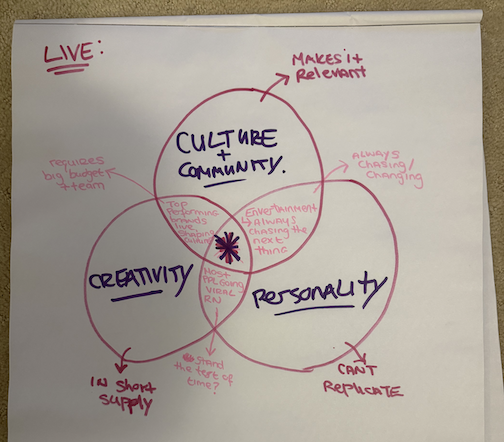
The Triple Threat Content Set is a Venn diagram for making content no one can replicate. The three pillars are creativity, personality, and culture. Content that sits in all three earns attention, stays recognisably yours, and is relevant to the moment. Content that misses one of the three fails in a very predictable way.
I came up with this intersection while trying to work out why some brands post constantly yet never gain any real momentum, or why some creators appear to have "cracked the algorithm," only for it to be short-lived. The pattern was the same every time. They had two of the three pillars and kept working harder on the two they already had.
What each pillar means
Creativity is quickly becoming society's most valuable asset. In the era of AI slop, overused prompts and generic frameworks, our creative thinking is what differentiates us, not only from the robots, but from each other. In its own Venn diagram, creative solutions sit in the intersection of our inputs: lived experiences, media, books, and more. When it comes to content, creativity is the part that makes someone stop.
Personality is you. Your voice, your taste, your opinions, the things you find funny, the things you refuse to do. This cannot be replicated. Like creativity, it's an amalgamation of your experiences and worldview. As algorithms and AI tools push out more of the same responses, and we all start receiving the same inputs repeatedly, the side effect is groupthink at a global scale.
Even if you were to stop reading now (please don't 😅) and promise yourself you'd hold onto your personality and unique creative expression, and diversify your inputs away from new-age media, the world would be better for it. Creativity and personality are two things AI doesn't have. It creates a decoupage of what already exists and hopes no one notices.
The final pillar in the Triple Threat Content Set is culture and community. This is what creates the context. Culture and community mean different things, but for now, to keep this framework useful to as many people as possible, we'll look at them together.
Culture is the wider conversation, and it moves weekly. Community is your specific audience, and it moves slowly. Both decide whether your idea lands or flops.
What each pillar gives you on its own
Creativity is in short supply. Even brands that aren't short on tools or budget are short on ideas. That's why good creative stands out in a feed of a hundred yap videos.
Personality cannot be replicated. A competitor can buy your production quality, mimic your posting schedule and match your ad spend. They cannot buy your taste, perspective and lived experience. They cannot copy your essence, which, by definition, is "the basic and most important characteristic which gives something its individual identity" - Collins Dictionary
Culture, including community, is what makes your content and offer suite relevant. It's also the pillar that never sits still. That's why this framework holds up over time. Without the culture pillar, it quickly gets reduced to another flash-in-the-pan tactic.
Everything you learn about the current moment expires. We may draw from it later in the creativity pillar, but in any given moment, culture is shifting. This is one of the reasons business owners get stuck and come to me frustrated: what worked in 2022 isn't working anymore, because culture has moved on. To get your ideas to land, they have to be relevant to the consumer. They have to speak to real lived experiences, desires, pain points and worldview. Without that, people swipe.
What happens when you only have two pillars?
This is how I know this framework works. Each intersection produces a type of content we can point to right now.
Creativity plus culture, without personality
This is the big brand campaign that's stunning to look at, well-timed with where society is heading, and often very expensive.
It also has no owner. Swap out the logo at the end, and it still makes sense. Your competitor could hire the same agency and buy the same result next quarter.
The Jaguar rebrand in late 2024 is a good example. They dropped so much of what made Jaguar, Jaguar. The iconic leaping cat, the legacy typography, and any nod to its roots, all in favour of a generic typeface that could easily belong to a shampoo company or a high fashion brand. Beautifully art-directed, culturally timed toward electric luxury, and it landed with no one, because it had scrubbed out the personality that made it Jaguar.

Culture plus personality, without creativity
This is trend commentary. Fast to make, easy to watch, short shelf life.
This is entertainment content, and entertainment has to keep chasing the next thing. The reach is real, and it's the type of content social media was built for. But before you throw away your content strategy, this isn't ideal for a business or personal brand trying to showcase expertise outside the entertainment industry. This type of content doesn't compound, which matters for your buyer journey and your own sanity, because nothing about it is built to be revisited.
These are cheap views, and a space every content creator has dabbled in at some point. It's a great ego booster, and it feels like you're onto something until you realise 80 to 90 percent of those views aren't relevant to your niche and will never convert. If anything, they'll hurt you in reaching your ideal client.
Creativity plus personality, without culture
Of the three, this ages the best, but it often grows the slowest.
This is the original work you put effort into, gave plenty of value in, and did all the "right" things with, yet only 200 people saw it. This is the point where most people get discouraged. They start nitpicking their strategy, their expertise, their camera presence, and go searching for the elusive "missing piece." Cue downloading yet another hook library. 😅

Your hooks may need work, or your storytelling might need refining, but those are tactics. They're the frosting and sprinkles that make it appealing.
If you're presenting a buttercream turd (& no, I don’t mean the kind pictured 😳) you may fool people the first time, but you won't get a second chance.
The Triple Threat Content Set is the foundation piece. It's the cake recipe that's been handed down for generations. Once you've got it figured out, you'll always have it, and then you can experiment with the toppers.
Plenty of the strongest work sits here for a year before it gets picked up. This is why content coaches say "put in the reps." Not because the algorithm has a quota you must hit, but because more reps mean more opportunities to refine and improve.
There is a way to speed this up: infusing culture and community into your content. Without a cultural hook, there's no reason for the algorithm, or a human, to share it, regardless of how valuable or insightful it is. Using culture to inform your content cuts through the noise and makes you relevant. Your ideal client connects with your content and gets drawn into your world.
What sits in the middle
Content in the middle does all three jobs at once. It stops someone because the idea is good. It sounds like you and nobody else. It connects to something people are already thinking about.
That's a repeatable content system.
What makes this future-proof?
I've spent a lot of time, and a fair bit of money, on various frameworks. Some for research, others out of sheer frustration.
The problem with most of them is that they tell you exactly what to say and how to say it. Sounds ideal until you realise that's the exact problem that got us here in the first place. Everything ends up same-same. So I set three non-negotiables when developing the Triple Threat Content Set:
Any industry, any niche could use it and see immediate results
It had to be versatile enough to withstand shifts in trends, platforms and algorithms
It had to be repeatable. No more guesswork
Creativity and personality are yours, your indispensable IP. You bring them to every piece you make, whether you realise it or not. I'm encouraging you to bring a little more.
Your point of view and the value you bring stay the same, but culture resets. Last month's reference is obsolete. You just need to find a new one to make your point.
The middle of this framework is a repeatable process, not a repeatable output. You can reuse the method: bring the idea, bring yourself, then find the current angle. Two-thirds of the work is done before you even open the app.
The next layer this framework does not cover
These three pillars explain attention. They don't explain revenue. That's a second layer, and it comes down to one question: does this piece move someone closer to buying from you?
Work out the three pillars first. Everything else sits on top of them. Attention with no money is a hobby. Money with no attention becomes a grind.
FAQ
What is the Triple Threat Content Set? A three-pillar model for content strategy. The pillars are creativity, personality, and culture and community. Content that hits all three is very hard for a competitor to copy.
Why is personality the most important circle? Because it's the only one a competitor can't buy. Budget buys production. Research buys cultural relevance. Nothing buys your unique voice and essence.
Can content work with only two circles? Yes, and most content does. Each intersection works in a limited way and fails predictably. Big campaigns get copied. Trend content dies out fast. Original content struggles to get traction.
Does this only apply to social media? No. It applies to all content creation, including email, blogs, podcasts, video and paid ads. It works especially well anywhere you're competing for attention. It's also a good philosophy for a fulfilling life.
How is this different from other content frameworks? Most frameworks focus on outputs, which eventually time out. The Triple Threat Content Set focuses on inputs first, by showing you what goes wrong when a pillar is missing. It doesn't require starting from scratch or learning a whole new skill set, because almost nobody is missing all three. It works with what you've already got.
Who made this framework? Michelle McCarthy, founder of Studio Danu, a creative agency in Melbourne, Australia. It came out of client work across social strategy, copywriting and brand strategy. Michelle goes into this and other similar topics on her Instagram.
How do I know which pillar my content is missing? Look at your last ten posts. Mark each one with the pillar or pillars it hits. Whichever intersection shows up most is your ceiling. If you keep landing on culture plus personality, your ideas are the problem. If you keep landing on creativity plus culture, put more of yourself in the content.
Does the framework work for B2B as well as B2C? Yes. The pillars don't change, only the inputs do. Culture in B2B means the conversation happening in your industry, not what's trending. Personality still means your voice and opinions. Creativity still means the idea, the craft and the execution.
Can one piece of content sit in more than one overlap? No. A piece of content sits where it lands, not wherever you hoped. If it's missing your voice, meaning anyone could have said the same thing the same way, it's no longer personality-driven, no matter how creative or well-timed it is.
Which circle should I build first if I'm starting from nothing? Personality. It's the only one a competitor can't buy or copy. Creativity and culture both take time and some budget to build. Your voice is free, and it's already yours.
Stuck in one corner of this framework and can't find your way out? Get in touch. That's exactly the kind of mess I sort out for a living.

About the Author:
Michelle McCarthy is the founder and creative director of Studio Danu, a creative agency based in Melbourne, Australia. For the last 15+ years, she's worked across social strategy, brand marketing and launch campaigns, helping brands build content that converts instead of getting lost in the feed. Past projects have included Bank of America, Spotify and Google, to name a few.